
Learn how to file a DBA in Texas with this step-by-step guide. Understand Texas DBA requirements, filing fees, where to file, and how to stay compliant whether you’re a sole proprietor or an LLC.
If you’ve ever seen a business name that doesn’t match the owner’s legal name, there’s a good chance it’s operating under a DBA.
A DBA (Doing Business As) is a name a business uses that’s different from its legal name.
In Texas, the official legal term for a DBA is an Assumed Name. The filing itself is called a Texas Assumed Name Certificate.
For example:
If Maria Lopez runs a bakery called Hill Country Bakes, she must register a Texas sole proprietorship DBA. And, if Riverstone Ventures LLC sells clothing under the brand Lone Star Threads, the company would file a Texas DBA for LLC.
The goal of a DBA is simple: It lets a business operate publicly under a brand name that differs from its legal name.
However, many entrepreneurs misunderstand what a DBA actually does. Filing a DBA does not create a new legal entity, and it does not provide liability protection.
Instead, it functions as a public record showing who is operating behind a particular business name.
Understanding the Texas DBA requirements early can save a lot of confusion later, especially when it comes to opening bank accounts, signing contracts, or filing taxes under your business name.
So, let’s understand how to file a DBA in Texas.
But before that, let’s familiarize you with a few important things about a DBA.
Who Needs a DBA in Texas?
Here is a breakdown of when different business types must file a DBA:
✔️ Sole Proprietors: A sole proprietor must register a DBA if the business name is not the owner’s full legal name.
✔️ No DBA needed: John Smith running his business as “John Smith Landscaping.”
✔️ DBA is required: John Smith running his business as “Green Earth Landscaping.”
✔️ Partnerships: General partnerships must file a DBA if they use a trade name that is not the legal names of all partners.
✔️ LLCs and Corporations: An LLC or Corporation must file a DBA when it chooses to operate under a brand name that is different from its official, registered legal name.
Example: “Sunrise Holdings LLC” doing business as “Austin Candle Co.”
When a DBA Is Not Required
A DBA is generally not required if:
- The business is a sole proprietorship operating only under the owner’s full legal personal name (e.g., Jane A. Doe).
- The business is an LLC or corporation and is operating under a name that is exactly identical to its legally registered name with the state.
DBA vs LLC Formation
A DBA registers a business name, offering branding flexibility. An LLC, on the other hand, creates a distinct legal entity that provides liability protection.
Many entrepreneurs initially form an LLC and then register DBAs for additional names under that legal structure.
Texas DBA Requirements You Must Know Before Filing
If you’re planning to file a DBA in Texas (Doing Business As), officially called an Assumed Name Certificate, there are a few rules that catch people off guard.
Texas is pretty straightforward compared to many states, but there are still several compliance details you should know before you file, otherwise you might end up filing twice or correcting paperwork later.
Here are the key Texas DBA requirements you must know before filing:
1. Texas Calls a DBA an “Assumed Name Certificate”
In Texas, what is commonly referred to as a DBA (Doing Business As) is legally termed an Assumed Name Certificate by the Texas Secretary of State.
This official document serves a straightforward purpose:
To notify the state and the public that a business, which is legally registered under one name, is operating and conducting its business publicly under a different name (the “assumed name”).
2. Where You File Depends on Your Business Structure
Where you file your DBA depends on your business structure.
| Business Type | Where to File DBA |
| Sole Proprietorship | County Clerk |
| Partnership | County Clerk |
| LLC | Texas Secretary of State AND County Clerk (in most cases) |
| Corporation | Texas Secretary of State |
📌 Important: If your business operates in more than one county, you may be required to file a DBA in each county where you conduct business. For instance, a business operating in both Travis County and Williamson County would likely require two separate DBA filings.
3. Your DBA Name Must Be Unique (But Texas Doesn’t Fully Check)
While Texas does not strictly enforce name uniqueness with the same rigor applied to legal entity registrations (like LLCs or Corporations), there are critical restrictions your DBA name must adhere to:
- It cannot be misleading or imply a purpose or affiliation that does not exist.
- It cannot impersonate or be deceptively similar to an existing, registered business in the state.
- It cannot include restricted words such as bank, insurance, trust, or university without prior official approval from the relevant state agency.
📌 Crucial Step: Although Texas doesn’t guarantee uniqueness, it is highly recommended that you perform a search on the Texas Secretary of State business name search database before filing.
Failing to check can lead to confusion, potential legal issues down the line, and the discovery that another company is already actively operating under the same name.
4. Your DBA Certificate Must Include Specific Information
Texas mandates the inclusion of specific details when filing for an Assumed Name, commonly known as a DBA (Doing Business As):
- Legal Name of the Business Owner: This must be the full, legal name of the individual or entity that owns the business.
- Business Structure: You must clearly state the legal form of your business (e.g., sole proprietorship, general partnership, Limited Liability Company (LLC), corporation).
- The Assumed Name/DBA: This is the specific alternative name under which you will operate and conduct business.
- Business Address: The physical street address where the principal place of business is located.
- County of Operation: The county within Texas where the business primarily conducts its activities.
- Signature: The filing must be signed by the owner of the business or an individual authorized to act on behalf of the owner.
Additional Requirement for Formal Entities (LLCs or Corporations):
If the business owner is a formal entity like an LLC or a Corporation, the filing must also include the entity’s formation number. This number is the official identification number assigned to the entity by the Texas Secretary of State upon its initial formation.
5. Some Counties Require In-Person Filing
Texas permits DBA filings both online and in person, but not all counties offer online systems.
In counties without online filing, you must:
- Download and sign the required form.
- Submit the signed form at the county clerk’s office or mail the paperwork.
📌 Always check the local county clerk’s website for specific filing instructions before submitting.
DBA Filing Fee in Texas
The cost to file a DBA in Texas varies depending on the filing location.
| Filing Location | Typical Fee |
| County Clerk Office | $15 – $30 |
| Texas Secretary of State | ~$25 |
If your business operates in more than one county, your total cost will increase as you must file in each county.
Be aware that some counties charge extra for certified copies, which are often required by banks to open a business account.
🔖 Related Read: 12 LLC Myths vs. Facts for US Businesses
How to File a DBA in Texas: Step-by-Step Process
In Texas, a DBA is filed as an Assumed Name Certificate. The process itself is not very complicated, but it changes depending on what kind of business you have. A sole proprietor does not file the same way an LLC does.
Below is the practical Texas DBA filing process, broken down step-by-step so you can file correctly the first time.
Step 1: Confirm Name Availability
Before you file, check whether the name is already being used. This does not mean Texas is going to “reserve” the name for you.
A DBA is not the same as forming an LLC under a unique legal name. But you still want to avoid picking something that is already floating around in your market, especially if another business is already using it publicly.
If you are a sole proprietor or general partnership, start with the county clerk records in the county where you plan to operate. That is where assumed names are usually recorded for unincorporated businesses.
If you have an LLC or corporation, check the Texas Secretary of State business records as well. That is especially important if the name is close to an existing registered entity name.
A bank may hesitate if the name looks too close to another business. Customers may confuse you with someone else. And if the name is already protected through a trademark, the issue gets more serious.
A DBA filing by itself does not give you exclusive rights to the name. It only puts your use of that name on record.
Step 2: Complete the Assumed Name Certificate
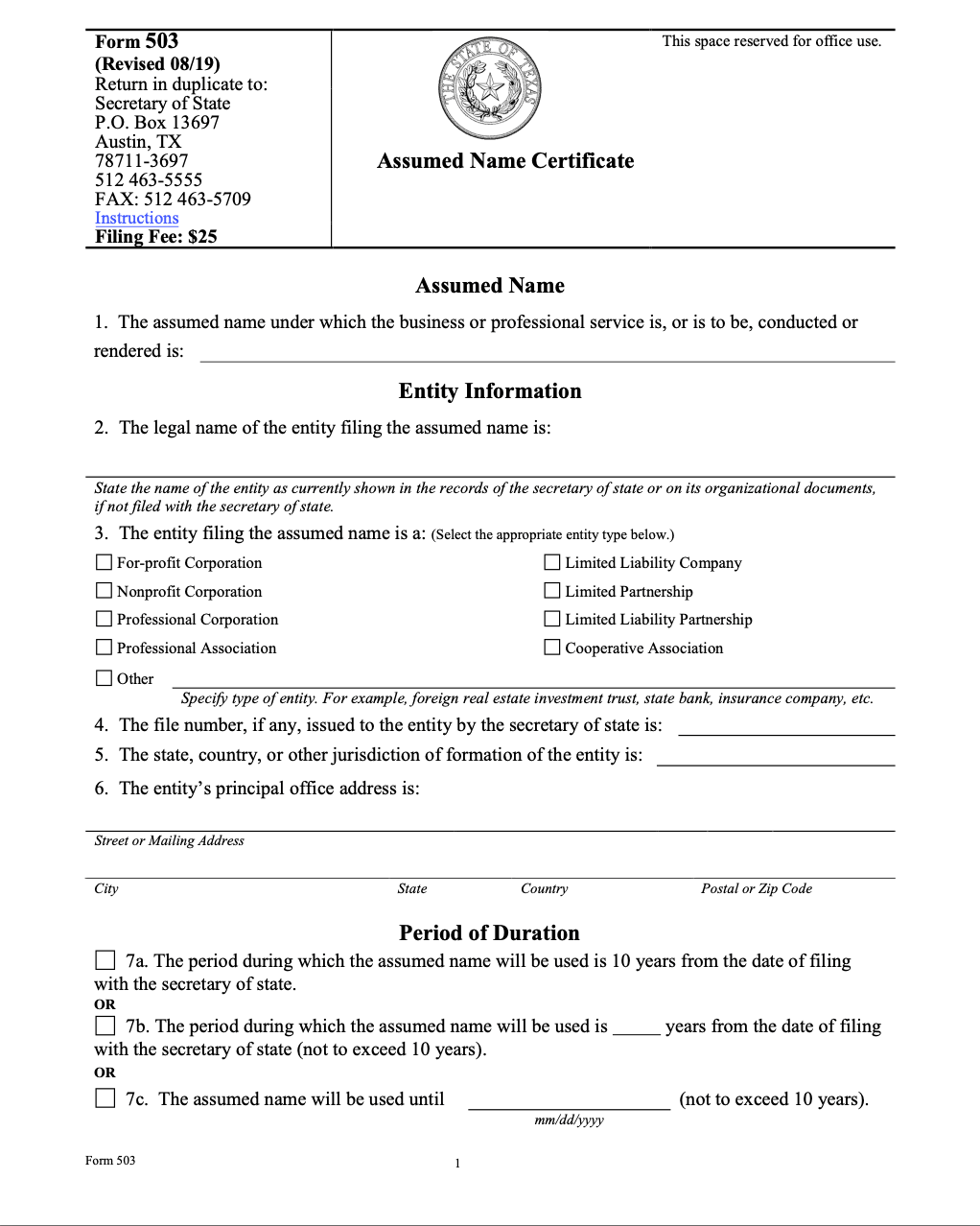
Once you are confident about the name, the next step is filling out the Assumed Name Certificate.
The exact format can vary depending on whether you are filing with a county clerk or through the state, but the core information is mostly the same.
You will usually need to provide your legal name or the legal name of the business entity, the DBA you want to use, your business address, the type of business, and the counties where the business will operate.
If you are filing as an LLC or corporation, you will also need your state file number.
Texas also asks how long you want the assumed name to remain in effect, up to the maximum allowed period.
One thing to watch here is signing requirements.
Some counties want the form notarized. Some may accept it without notarization if you sign it in person. This is one of those very unglamorous details that people miss and then get their filing delayed for no good reason.
So, it is worth checking the county clerk’s instructions before you print and sign anything.
Step 3: Submit the Filing
After the form is complete, you submit it to the right office.
For sole proprietors and general partnerships, that usually means the county clerk in each county where the business operates.
For LLCs and corporations, it usually means the Texas Secretary of State, and depending on the situation, you may also need a county-level filing.
There are usually three ways to file:
- In person: This is often the simplest route if you are filing at the county level. You take the form, pay the fee, and in some counties you may get it processed pretty quickly.
- By mail: This works fine too, but naturally it takes longer. You need to send the completed form, the fee, and anything else the county or state office requires.
- Online: If you have an LLC or corporation, you may be able to file a DBA in Texas online through SOSDirect. For many business owners, this is the fastest way to handle a state-level assumed name filing without dealing with paper forms.
The Texas DBA filing fee depends on where you are filing.
Processing times are all over the place. Some county offices handle in-person filings fast. Mailed filings can take days or longer. Online submissions through the state are usually more efficient, but it still depends on workload.
Step 4: Keep Proof for Banks and Contracts
Once your DBA is filed, keep a copy of it somewhere you can actually find later. Not in the mysterious folder where documents go to die.
This matters because banks often want proof of the DBA before they let you open an account under that name. If you plan to receive payments, sign contracts, or issue invoices using the DBA, the paperwork needs to back that up.
In a lot of cases, a regular copy is not enough.
Banks may ask for a certified copy of the filing. That is why many people request one at the time of submission instead of scrambling for it later.
You should also make sure the name is reflected consistently across your business documents. That includes contracts, invoices, vendor records, and anywhere else the business name shows up.
If your paperwork says one thing and your bank records say another, it creates friction you do not need!
| Filing a DBA in Texas by Business Type The filing process is not one-size-fits-all in Texas. The paperwork may look similar, but the filing authority depends on the business structure. ✔️ Sole Proprietors That part is easy to overlook. Someone assumes one filing covers the whole state, then later realizes their business activity stretches beyond that county. Texas does not really reward assumptions in paperwork. A Texas sole proprietorship DBA is basically how you tell the public, “I am doing business under this name, even though I am not a separate legal entity.” ✔️ General Partnerships If the partnership operates across multiple counties, multiple county filings may be required. ✔️ LLCs and Corporations If the business wants to operate under a name other than its legal entity name, it usually files the assumed name certificate through the Texas Secretary of State. This is common when an LLC has one legal name but wants to market itself under a different brand. For example, an LLC may be registered under one formal name but sell its services, run its website, and invoice clients under another. That is where the DBA comes in. It lets the business use that public-facing name without changing the actual entity name on file. |
What a Texas DBA Does (and Does NOT Do)
Here is a breakdown of what a Texas DBA actually does for you, and the legal protections it does not provide.
What a Texas DBA Does
1. Legalizes Your Branding
If your name is John Doe but you want to call your landscaping business “Lone Star Lawns,” Texas law requires you to register that name.
A DBA allows you to legally use this brand name on business cards, signs, and your website.
2. Enables Business Banking
Most banks in Texas will not allow you to open a business checking account or cash checks made out to a business name unless you provide a certified copy of your Assumed Name Certificate.
3. Provides Consumer Transparency
The primary purpose of the Texas Assumed Business and Professional Name Act is consumer protection. It ensures that if a customer has a dispute with “Lone Star Lawns,” they can look up the public record to find out that John Doe is the actual person responsible.
4. Allows for Multiple Brands
If you already have a Texas LLC (e.g., “Doe Enterprises, LLC”), you can file multiple DBAs under that single entity. This lets you run a coffee shop, a bookstore, and a consulting firm as separate brands without the cost of forming three separate LLCs.
5. Enhances Privacy (For Sole Proprietors)
It allows you to keep your personal name out of your day-to-day marketing and customer interactions, providing a small layer of professional distance.
What a Texas DBA Does Not Do
1. It Does NOT Provide Liability Protection
A DBA is not a legal entity. If you are a sole proprietor with a DBA and your business is sued, your personal assets (home, car, savings) are at risk. To get “limited liability,” you must form an LLC or Corporation.
2. It Does NOT Give You Exclusive Ownership of the Name
Registering a DBA in Texas (especially at the county level) does not stop someone else from using a similar name. It is merely a “notice filing.” If you want exclusive rights to a name across the state or country, you need a Trademark.
3. It Does NOT Change Your Taxes
A DBA is “transparent” for tax purposes. If you are a sole proprietor, you still file your taxes on your personal Form 1040 (Schedule C). It does not provide any special tax breaks or corporate tax status.
4. It Does NOT Last Forever
In Texas, an Assumed Name Certificate is valid for 10 years. You must renew it before it expires, or you lose the legal right to use that name for business transactions.
Common Mistakes to Avoid When Filing a DBA in Texas
Figuring out how to file a DBA in Texas is not complicated once you know where to file and how your business is set up.
The real confusion usually starts when people assume the process is the same for everyone. It isn’t. A sole proprietor does not file the same way an LLC does, and sending the paperwork to the wrong office can slow things down fast.
Once you know whether your filing goes to the county clerk or the Texas Secretary of State, the process becomes much easier to handle.
That said, there are still a few mistakes that can create problems later. Before you file your Texas DBA, it helps to know where people usually slip up. Let’s go through them.
Filing At The Wrong Level (County Vs. State)
Texas splits assumed name filings depending on the type of business entity.
Sole proprietors and general partnerships typically file their DBA with the county clerk where the business operates.
LLCs and corporations, on the other hand, generally file assumed names with the Texas Secretary of State.
This is where many business owners slip up. They assume there is one statewide filing that covers everything, submit the form, and move on.
Later, when a bank or contract review asks for documentation tied to the correct filing authority, they realize the paperwork was submitted to the wrong office.
📌 Our advice here is simple: Always confirm your entity type first, and then confirm the correct filing authority.
Assuming The DBA Name Is Automatically Protected
Like we mentioned earlier, a DBA registration does not give you ownership of the name. It simply records that your business is using that name publicly.
Another company may still operate under a similar name, particularly if they registered it in a different county or if they hold a trademark.
This is why we always recommend doing more than the minimum required search. Look at county records, check the state entity database, and run a quick trademark search through the United States Patent and Trademark Office.
A DBA filing helps with transparency, not exclusivity.
If brand protection matters to your business, that conversation usually moves into trademark territory.
Using The DBA Before The Filing Is Completed
Business owners often get excited about the brand name and start using it immediately, on invoices, contracts, or a website.
From a compliance standpoint, that’s quite risky.
Banks may refuse to open an account under the DBA name without proof of the filing. Vendors might question contracts if the operating name does not match official documentation.
And payment processors can pause onboarding if the name appears inconsistent.
📌 Our rule of thumb to avoid such challenges: File first, use second. Waiting a few extra days for the paperwork to be on record is far easier than cleaning up documentation later.
Forgetting The 10-Year Renewal Requirement
Texas assumed name certificates do not last forever.
Most DBA filings expire after 10 years.
This catches many business owners off guard. The name becomes part of the company’s brand, the paperwork gets forgotten, and a decade later the assumed name quietly expires.
From a compliance perspective, that can create issues with bank records, vendor agreements, and contract enforceability if the DBA is technically no longer active.
Treat the renewal like any other compliance deadline. Set a reminder well before the expiration date so the filing can be renewed without disrupting operations.
🔖 Related Read: What Is doola Tax and Compliance? Your Complete Guide to Stress-Free U.S. Business Compliance
Not Updating The DBA After Business Changes
Business details change all the time. Companies move offices. Ownership structures evolve. Contact information gets updated.
When that happens, the assumed name record may also need to be updated.
If the address or entity information connected to the DBA becomes outdated, banks and regulators may flag the mismatch. It is a small administrative step, but it keeps the record aligned with how the business actually operates.
📌 Our perspective here is simple: Your DBA filing should mirror reality. If the underlying business details change, the filing should change too.
Not Aligning The DBA With Tax And Financial Records
One of the most overlooked issues is document consistency.
Inconsistencies, such as different names on bank accounts, invoices, and tax forms, can create unnecessary complications.
Ensure all business documents are consistent after registering a DBA.
Keeping supporting records, like bank accounts, contracts, and tax registrations, aligned with your DBA and legal entity simplifies verification for payment processors, lenders, and accountants, making the business smoother to operate.
So, start treating the DBA filing as a key part of business compliance, not just a single administrative task.
Do You Need an LLC Instead of a DBA?
A lot of people look at a DBA because it feels like the simpler move.
Less paperwork. Lower cost. Faster to get going. And for some businesses, that is enough for the moment.
But a DBA and an LLC are not substitutes in the real sense. They solve different problems.
A DBA helps with how your business appears in public. An LLC deals with how your business exists legally.
That difference matters more than people think.
A DBA Works For Naming. An LLC Works For Structure.
If all you need is to operate under a business name that is different from your personal name or registered company name, a DBA can do that job.
It helps you brand the business properly, use that name in day-to-day operations, and keep things looking consistent on the surface.
But that is where its role ends.
A DBA does not create separation between you and the business. It does not reduce legal exposure. It does not give the business its own legal shell.
An LLC does.
That is why this choice should not be treated like branding paperwork. It is really a question of risk, liability, and how seriously the business needs to be structured from day one.
When A DBA May Be Enough
There are cases where a DBA is perfectly reasonable.
Let’s say you are testing a small service business, running a solo consulting practice, or taking on limited client work under a brand name. In that kind of setup, a DBA may be enough to get the name on record and keep things operationally neat.
It can make sense when the business is still lean, early, and not carrying much legal or financial exposure.
Still, this is where people should be honest with themselves. Small does not always mean low-risk. A business can look simple on the outside and still create liability through contracts, client disputes, payments, or compliance issues.
The more important question is not, “Can I start with a DBA?” but rather, “What risks am I exposing myself to if I don’t establish a formal business structure?”
When An LLC Is Usually The Better Decision
Once a business starts generating consistent income, entering into agreements, hiring employees, selling products, or dealing with a high volume of customers, forming an LLC is generally the better choice.
The primary benefit is not about appearing more professional, but about establishing a crucial legal separation.
This boundary is vital for protection when issues arise.
From a business operations perspective, an LLC streamlines interactions. Banks, online platforms, suppliers, and major clients often prefer the straightforward documentation and formal structure that an LLC provides, which significantly reduces the operational friction of using a DBA under an individual’s name.
The goal is not to appear larger, but to preemptively simplify and organize the business to avoid future complications.
doola’s Take
A DBA (Doing Business As) is suitable for casual, low-risk, or test-phase businesses and primarily helps you operate under a desired name, making you look organized.
For example, if someone is doing early-stage freelance work, testing a side business, or offering services on a very small scale, a DBA may be enough for the moment.
But we would not treat that as a long-term setup unless the business is staying extremely small and low-risk.
An LLC (Limited Liability Company) is the wiser choice when there is real exposure (money, clients, contracts, etc.) as it provides the necessary legal structure and protection.
In short: A DBA helps you look organized; an LLC helps you stay protected.
We would start with the LLC, then add a DBA only if the brand name needs to be different from the legal name.
That approach is usually cleaner. It avoids backtracking. And it saves people from fixing the structure later, once the business already has momentum.
DBA vs LLC: Long-Term Cost Breakdown (What You’ll Actually Pay Over Time)
A DBA has low, one-time costs, while an LLC is a recurring investment that protects your personal finances as your business grows.
Here’s a clear comparison of how DBA and LLC costs add up over a 5-year period:
| Feature | DBA (Sole Prop) | LLC (Entity) |
| Upfront Cost | $20 – $100 | $150 – $800 (incl. Operating Agreement) |
| 5-Year Maintenance | ~$100 (Total) | $500 – $4,000 (State dependent) |
| Tax Strategy | Fixed: All profit taxed at ~15.3% SE tax. | Flexible: Can switch to S-Corp to save $3k-$10k/year in taxes. |
| Banking & Credit | Limited to personal credit score. | Builds Business Credit (Lower interest rates over time). |
| Personal Risk | Unlimited: Your house/car are “on the table” for debts. | Limited: Personal assets are legally shielded from business debt. |
| The “Break-Even” Logic
To decide which is actually “cheaper” for you, look at these 3 triggers: ✔️ The $60,000 Profit Mark Once your business nets over $60,000, the tax savings from an LLC (taxed as an S-Corp) usually far outweigh the $300–$800 annual state fees. At this point, an LLC is “cheaper” than a DBA. ✔️ The Asset Threshold If you own a home or have more than $20,000 in savings, the “cost” of a DBA includes the potential loss of those assets in a lawsuit. The LLC fee acts as a legal insurance premium. ✔️ The Scalability Factor If you plan to hire employees or sign a commercial lease, a DBA is high-risk. Most landlords and insurance providers offer better terms to LLCs because the entity is seen as more permanent. |
Start Your Texas Business The Right Way With doola

If you’ve been researching how to file a DBA in Texas, there’s a good chance you’re also thinking about the bigger question: How the business should be structured.
That’s where doola comes in.
Instead of navigating multiple government systems, forms, and compliance rules on your own, doola helps entrepreneurs handle the core setup and operational requirements of a U.S. business.
🚀 Texas LLC Formation
If you decide that an LLC makes more sense than operating under a DBA alone, doola helps handle the Texas LLC formation process from start to finish.
That includes preparing and filing the formation documents with the state, ensuring the company is properly registered, and helping you move from idea to a legally recognized Texas business entity without dealing with multiple state filings yourself.
🚀 EIN Registration
Most businesses need an EIN from the IRS to open a business bank account, pay taxes, or hire employees.
doola assists with the EIN application process, helping submit the required information to the IRS so the business can receive its federal tax ID and move forward with banking and payments
🚀 Registered Agent Services
Every Texas LLC must list a registered agent who can receive official legal and government notices on behalf of the company.
doola provides registered agent services, ensuring the business has a compliant address on file and that important legal correspondence is received and handled properly.
🚀 Ongoing Compliance Support
Forming a company is only the beginning. Businesses must stay in good standing by keeping records updated and meeting state and federal requirements.
doola helps manage ongoing compliance tasks, so the company remains properly maintained rather than falling out of good standing due to missed administrative obligation
🚀 Sales Tax And Federal Tax Guidance
Understanding tax responsibilities, especially for online businesses or companies selling across states can be confusing.
doola provides guidance to help businesses stay compliant with both federal tax obligations and sales tax rules.
Book a demo to get more info about starting your own LLC in Texas.
FAQs

How much does it cost to file a DBA in Texas?
The Texas DBA filing fee depends on where you file.
If you are a sole proprietor or partnership, you typically file with the county clerk, and the fee usually ranges between $10 and $25 per county. Some counties may charge slightly more depending on notarization or additional pages.
If you are an LLC or corporation, you file an assumed name certificate with the Texas Secretary of State, and the filing fee is generally $25.
If your business operates in multiple counties and you are filing at the county level, you may need to pay the fee in each county where the business operates.
Can I file a Texas DBA online?
Yes, but it depends on your business structure.
If you operate an LLC or corporation, you can usually file a DBA in Texas online through the Texas Secretary of State’s SOSDirect portal.
For sole proprietors and partnerships, the filing is handled by the county clerk, and many counties still require the form to be submitted in person or by mail. Some counties offer limited online filing options, but this varies by county.
Do I need to publish my DBA in a newspaper in Texas?
No. Texas does not require newspaper publication for DBAs.
Unlike some states that require businesses to publish a notice in a local newspaper, Texas only requires that the assumed name certificate be filed with the correct office—either the county clerk or the Texas Secretary of State depending on the business type.
How long does a DBA last in Texas?
A Texas assumed name certificate is valid for up to 10 years from the date it is filed.
If you want to continue using the name after that period, you will need to renew the filing by submitting a new assumed name certificate before it expires.
Can two businesses have the same DBA in Texas?
Yes. Texas does not grant exclusive rights to a DBA name.
Multiple businesses can legally register the same assumed name, because a DBA filing simply records who is operating under that name. It does not function like a trademark.
For that reason, it’s smart to check existing business records and trademarks before choosing your DBA.
Do I need a DBA if I already have an LLC in Texas?
You only need a DBA if your business operates under a name different from your LLC’s registered legal name.
For example:
- Hill Country Ventures LLC selling services as Hill Country Ventures LLC → No DBA needed
- Hill Country Ventures LLC operating as Austin Candle Company → DBA required
In this situation, you would file a Texas DBA for LLC with the Texas Secretary of State.
What happens if I don’t file a DBA but operate under a different name?
Operating under a business name without filing a DBA can create legal and practical problems.
For example, you may run into difficulties:
- Opening a business bank account
- Signing contracts under the business name
- Receiving payments or checks made out to the business name
- Proving ownership of the business name in disputes
Filing the Texas assumed name certificate helps create a public record showing who is behind the business name, which makes it easier to conduct business legally and transparently.
PakarPBN
A Private Blog Network (PBN) is a collection of websites that are controlled by a single individual or organization and used primarily to build backlinks to a “money site” in order to influence its ranking in search engines such as Google. The core idea behind a PBN is based on the importance of backlinks in Google’s ranking algorithm. Since Google views backlinks as signals of authority and trust, some website owners attempt to artificially create these signals through a controlled network of sites.
In a typical PBN setup, the owner acquires expired or aged domains that already have existing authority, backlinks, and history. These domains are rebuilt with new content and hosted separately, often using different IP addresses, hosting providers, themes, and ownership details to make them appear unrelated. Within the content published on these sites, links are strategically placed that point to the main website the owner wants to rank higher. By doing this, the owner attempts to pass link equity (also known as “link juice”) from the PBN sites to the target website.
The purpose of a PBN is to give the impression that the target website is naturally earning links from multiple independent sources. If done effectively, this can temporarily improve keyword rankings, increase organic visibility, and drive more traffic from search results.

